
Beyond the Sticky Note: How LEGO® SERIOUS PLAY® Creates Better Team Conversations
Ask a group of leaders to solve a complicated problem and you can probably predict what happens next.
A facilitator asks a question.
A few people begin contributing.
Someone starts capturing ideas on a whiteboard or sticky notes.
The people most comfortable thinking out loud naturally become more visible in the conversation.
Eventually, the group arrives at some version of an answer.
There’s nothing inherently wrong with that approach.
But it raises an important question:
Did you actually hear what everyone was thinking?
That’s one of the challenges LEGO® SERIOUS PLAY® can help address.
At Claria Partners, we use LEGO SERIOUS PLAY to help leadership teams approach conversations about communication, collaboration, alignment, change, and other complex organizational issues in a different way.
And while the colorful bricks are what people notice first, the real value comes from what happens once people start building.
What Is LEGO SERIOUS PLAY?
LEGO SERIOUS PLAY is a facilitated methodology in which participants respond to questions by building three-dimensional models with LEGO bricks and then explaining the thinking and meaning behind those models.
A typical experience follows a simple rhythm:
Question. Build. Storytell. Reflect.
The facilitator presents a prompt.
Everyone constructs a response.
Participants tell the stories represented by their models.
Then the group reflects, asks questions, and begins identifying connections across different perspectives.
The model isn’t an arts-and-crafts project.
It’s a thinking tool.
Why Build Instead of Simply Talk?
Claria facilitator Michelle Kempskie describes the process as helping participants “think through their fingers.”
Instead of immediately reaching for the most obvious verbal response to a question, participants have to create something that represents what they’re thinking.
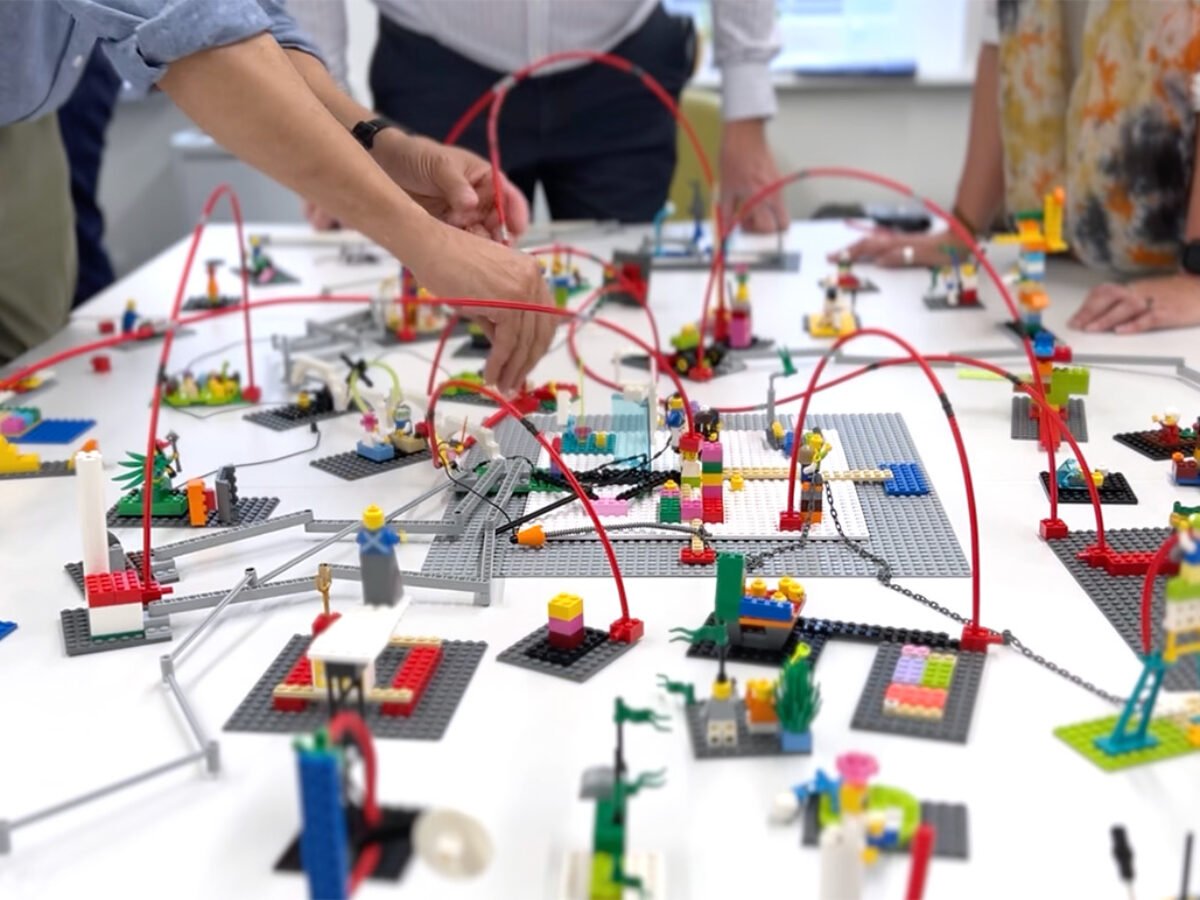
A wall might represent an organizational barrier.
A bridge could symbolize stronger communication.
A disconnected figure might represent someone who doesn’t feel included.
A tower might represent stability.
The meaning belongs to the person who built the model.
That’s why storytelling is such an important part of the experience.
The bricks make an abstract idea tangible.
The story makes the thinking behind it understandable.
Everyone Has a Model. Everyone Has a Voice.
Think about your last leadership or team meeting.
Who spoke first?
Who spoke most?
Whose perspective shaped the direction of the conversation?
And who may have had something valuable to contribute but never found the right opening?
Traditional meetings can unintentionally favor people who think quickly, speak confidently, and are comfortable entering a conversation in real time.
LEGO SERIOUS PLAY changes the mechanics.
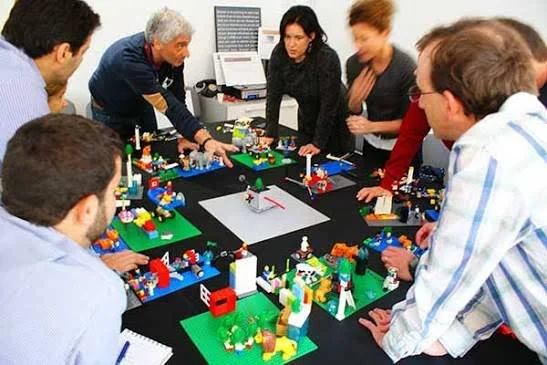
Everyone builds.
And everyone has an opportunity to explain what they built.
That structure can help teams hear perspectives from people who might otherwise contribute less frequently in a traditional group discussion.
It also shifts attention away from who has the loudest voice and toward the ideas represented in the models.
Michelle’s Perspective
“Individual building allows participants to explore their ideas and question their assumptions through piece selection and placement. Because everyone must build and share, the ‘loudest voice in the room’ is not the only one the team hears.
As each participant tells the story of their ideas through their model, passion shines through, even from the introverts and quietest team members. Questions become about the model, for example, ‘What is the meaning behind the color, shape, or placement of a piece?’ And varied interpretations always add perspectives even the builder hadn’t anticipated.”
Michelle Kempskie, Claria Partners Facilitator
From Individual Perspectives to Shared Understanding
The process doesn’t necessarily end with individual models.
One of the most powerful applications is bringing different perspectives together.
Participants may begin by constructing their own representation of a challenge, opportunity, team dynamic, or organizational priority.
Those individual perspectives can then become the starting point for a larger conversation.
Teams can identify common themes.
Explore important differences.
Challenge assumptions.
And begin constructing a shared picture of what they collectively see.
The progression looks something like this:
My perspective → Your perspective → Our shared understanding
That distinction matters.
Rather than asking everyone to negotiate the group’s answer immediately, participants first make their own thinking visible.
Only then does the group begin constructing a collective picture.
When Does LEGO SERIOUS PLAY Make Sense?
LEGO SERIOUS PLAY probably isn’t necessary for the 15-minute meeting where you simply need to make a quick decision.
Its strength is in helping teams deepen and expand important conversations.
Potential applications include:
• Leadership team development
• Team dynamics and ways of working
• Communication and collaboration
• Strategic planning and visioning
• Values and organizational alignment
• Managing organizational change
• Project planning and kickoffs
• Project reviews and retrospectives
• Cross-functional collaboration
• Leadership and team coaching
• Renewing team energy and commitment
These are often situations where the challenge isn’t simply finding more information.
It’s understanding how different people see the situation, identifying what may be beneath the surface, and developing stronger shared understanding.
Why LEGO SERIOUS PLAY Can Work Well for Leadership Offsites
Leadership offsites are often designed to create space for conversations that don’t happen during normal operating meetings.
But simply changing the location doesn’t necessarily change the conversation.
Teams may still fall into familiar roles.
The same people may dominate.
The same assumptions may go unchallenged.
The same meeting habits can follow everyone into a different conference room.
LEGO SERIOUS PLAY introduces a genuinely different way of engaging with the questions in front of the team.
Rather than simply asking participants to discuss the future, describe a challenge, or react to someone else’s idea, the methodology asks them to first create and explain their own perspective.
That can make it particularly useful when the purpose of an offsite is to create greater alignment, strengthen collaboration, or explore difficult questions from multiple perspectives.
Serious Challenges Can Benefit From Play
The word play can understandably make some leaders skeptical.
But that is also part of what makes the methodology interesting.
Organizations frequently ask people to generate new ideas while putting them into exactly the same conference rooms, conversations, and meeting structures they’ve experienced dozens of times before.
Sometimes changing the way people think together changes what they’re able to discover together.
The LEGO bricks are simply the medium.
The goal is better communication.
Greater participation.
Richer perspectives.
Stronger alignment.
And ultimately, better team performance.
Build it. Share it. See it differently.
Ready to Explore a Different Kind of Team Conversation?
Planning a leadership offsite, team effectiveness workshop, or important strategic conversation? Claria Partners can design a LEGO SERIOUS PLAY experience around the specific challenge your team needs to address. Contact us to start the conversation.